
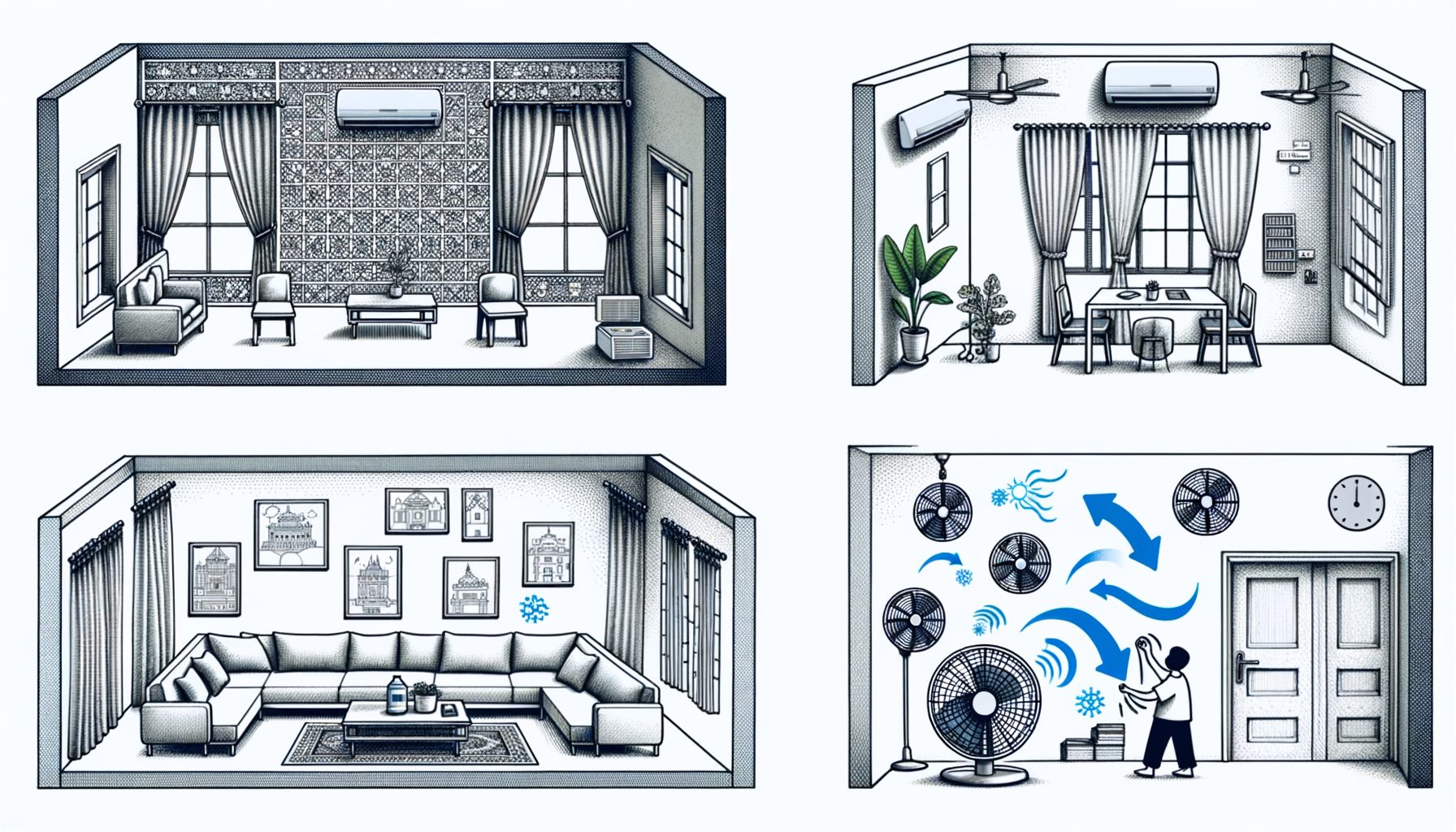
Big rooms can stay stubbornly warm, even while the air conditioner runs hard. To get maximum AC cooling in large spaces, you need more than a colder setpoint—you need a plan. In the pages below, you’ll see why big spaces resist cooling and how to fix it. We’ll walk through pro-level strategies to boost airflow, manage heat load, and dial in controls. By the end, you’ll know how to get fast, even, efficient cooling without wasting energy or money.
The Core Problem: Why Big Rooms Feel Warm Even with the AC On
Large rooms challenge air conditioners for three main reasons: high heat load, poor air mixing, and capacity mismatches. Start with heat load. Bigger spaces expose more surface area and often more windows, which means more sun-driven heat (solar gain). When a room faces west or uses floor-to-ceiling glass, the radiant load can spike in the afternoon and push your AC to the limit. Add people, lights, and electronics, and both sensible and latent loads climb. In plain terms: more heat is entering than your AC can remove quickly.
Air mixing is the next hurdle. Cold air supplied from one corner often “pools” near vents or the floor, while warmer air stratifies near the ceiling. Without deliberate mixing, parts of the room stay warm; the thermostat may read the right temperature while you feel hot across the room. High ceilings amplify this effect because heat rises and forms a warm layer overhead. A high return grille can help by pulling from the top layer, yet poorly placed supplies and returns can cause the AC to recirculate air without evenly cooling people at seating height.
Capacity and delivery also matter. An undersized system can’t keep up in peak conditions; it runs constantly and barely moves the needle. Oversized units short-cycle—cooling quickly, shutting off before humidity is removed, and leaving the room clammy and uneven. Duct design adds another wrinkle: poorly sized or leaky ducts may lose 20–30% of cooling before it reaches the room, according to efficiency programs like ENERGY STAR. Even spotless filters and brand-new equipment can be hamstrung by high static pressure or closed vents that choke airflow.
Humidity magnifies discomfort. At high relative humidity (above ~60%), your body’s natural cooling (sweating) becomes less effective. The air may be 24°C/75°F, yet it feels hotter. Then this: you drop the thermostat further, raising energy costs while masking the root problem—insufficient latent removal and airflow. Understanding these drivers—load, mixing, capacity, ducts, and humidity—marks the first step toward solving the “always warm” large room.
Right-Size and Right-Place: Sizing, Zoning, and Strategic Placement
In large rooms, proper capacity and smart placement deliver the fastest comfort gains. Begin with a load estimate. Professionals use Manual J calculations, but you can form a quick rough-in. A common rule of thumb is about 20 BTU/hour per square foot in moderate climates for typical 8-foot ceilings, then adjust for sun, occupants, and ceiling height. For oversized spaces or tall ceilings, plan on more capacity, better distribution—or both. When one unit can’t push enough cool air across the room, a multi-split with two indoor heads or a central system with multiple supplies and a dedicated return often outperforms a single blast from the corner.
Placement can be just as critical as capacity. Aim supplies to throw air across the occupied zone (sofa and desk height), not straight down onto a thermostat or directly toward a return. Separate supply and return locations to sweep the entire room. With a wall-mounted split unit, mount it to blow along the longest throw possible rather than at a nearby wall. For central systems, make sure the large room has its own return or a clear return path; otherwise, pressure imbalances may starve it of cool air.
Open plans and multiple large areas often benefit from zoning or multiple indoor units. Variable-speed (inverter) systems shine here—they modulate output to maintain even temperature and manage humidity better, reducing short cycling and drafts. What’s interesting too: in spaces with extreme sun exposure or frequent gatherings, supplementary cooling (a second indoor unit or a ducted branch with a booster fan) usually beats oversizing the main unit.
Here’s a starting point for capacity. Always confirm with a professional calculation for best results.
| Room Size | Ceiling Height | Base Capacity (Moderate Climate) | Typical Adders |
|---|---|---|---|
| 300 ft² (28 m²) | 8 ft (2.4 m) | ~6,000 BTU/h (20 BTU/ft²) | +10–20% for strong sun; +600 BTU/h per extra person beyond 2; +10% for 9–10 ft ceilings |
| 500 ft² (46 m²) | 8–9 ft (2.4–2.7 m) | ~10,000 BTU/h | +10–25% for west/south-facing glass; +600 BTU/h per extra person beyond 3; +15% for 10–12 ft ceilings |
| 800 ft² (74 m²) | 9–12 ft (2.7–3.7 m) | ~16,000 BTU/h | Consider dual supplies/heads; +20–30% for heavy sun or large window walls |
| 1,000 ft² (93 m²) | 10–12 ft (3.0–3.7 m) | ~20,000 BTU/h | Often needs multi-zone or multiple heads; kitchen use can add 3,000–4,000 BTU/h |
Key tips: choose inverter/variable-speed equipment for better comfort and efficiency. If ducted, size for 350–450 CFM per ton of cooling and ensure the large room gets its share. Avoid aiming cold air at thermostats, which can cause early shutoff. Finally, if upgrading equipment isn’t feasible, rebalancing ductwork, adding a dedicated return, or deploying a secondary head/mini-split just for the large room can be transformative.
Helpful resources: U.S. DOE AC basics (EnergySaver), ENERGY STAR cooling guide (ENERGY STAR), and ACCA for professional standards (ACCA).
Airflow Is King: Fans, Ducts, and Door Strategy for Even Cooling
Even top-tier AC struggles without strong, balanced airflow. Think of airflow as the delivery truck for cooling. When the truck is slow, leaks, or gets stuck in one neighborhood, the goods never reach you. Start with vents: fully open all supply registers in the large room and aim vanes to spread air widely. If flow feels weak, try a quick test—hold a tissue at the register to see if air pushes or pulls strongly. For ducted systems, a properly sized setup delivers roughly 350–450 CFM per ton of cooling. Fall far below that and comfort suffers; coils can even ice over.
Leaky or undersized ducts are common in older homes. According to ENERGY STAR, ducts can lose 20–30% of air through leaks. Joints should be sealed with mastic (not cloth “duct tape”), and ducts running through hot attics or garages ought to be insulated. Have a technician measure static pressure and balance dampers so the large room gets enough supply air. If the room sits at the end of a long run, an inline booster fan can help—but it’s a band-aid when the main system under-delivers.
Ceiling fans are the low-cost superpower. Set them counterclockwise in summer to push air downward, increasing evaporative cooling on your skin without lowering the thermostat. A good fan can make 24–26°C (75–78°F) feel 2–3°C cooler, letting you raise the setpoint and stay comfortable. In large rooms, two or more ceiling or pedestal fans positioned for cross-flow break up hot spots. Keep speeds moderate to reduce noise while maintaining strong circulation.
Return air pathways are essential. Close the door to a large room with no return, and the AC may pressurize the space and starve it of incoming cool air. Provide a clear return path: leave doors open during cooling, add a jump duct, or ensure a 19–25 mm (3/4–1 inch) undercut under the door. Without this, pressure imbalances push cooled air through cracks instead of sweeping the room.
Filters matter, too. High MERV filters clean better but can cut airflow if the blower can’t handle the added resistance. For most homes, MERV 8–13 is a sweet spot; if you go higher, verify airflow and coil health. Replace or clean filters every 1–3 months during peak season. Well, here it is: avoid closing supply vents in other rooms to “force” more air to the large room. That raises static pressure, can increase duct leakage, and may damage the blower. Proper balancing or professional adjustments are the right tools. More airflow equals faster, more even cooling—treat it as a priority, not an afterthought.
Learn more about duct sealing and airflow best practices at ENERGY STAR: Ducts.
Beat the Heat Load: Sun, Humidity, and Smart Controls
Cutting heat load is like easing off the gas pedal while your AC hits the brakes—it shortens the stopping distance dramatically. Begin with the sun. Large rooms often have big windows; that’s where much of the heat enters. Use layered window strategies: close blinds or shades during peak sun hours, add reflective or low-e films to reduce solar heat gain by 30–60%, and consider insulated curtains. External shading (awnings, exterior shades, strategically placed trees) blocks heat before it enters. Choosing new windows? Look for low U-factor and low SHGC (solar heat gain coefficient) for hot climates. The U.S. DOE offers a practical overview of window attachments and their impact (EnergySaver: Window Attachments).
Now humidity. Comfort blends temperature with moisture. Aim for 40–60% relative humidity. If your AC short-cycles or your climate runs very humid, add a dehumidifier for the large room. Many homeowners find that dropping humidity from 65% to 50% allows a 1–2°C (2–3°F) higher thermostat setting with equal comfort. When using central AC, set the fan to AUTO, not ON; running the blower continually can re-evaporate moisture off the coil and raise indoor humidity. If your thermostat includes dehumidification or “cool to dehumidify” modes, enable them.
Smart control tactics often deliver the biggest wins for minimal cost. Pre-cool the large room 1–2 hours before peak heat (for example, before a party or afternoon sun). That timing lets the AC operate more efficiently when outdoor temperatures are lower and prevents the space from “soaking” with heat later. Schedule small setpoint changes rather than big swings; large setbacks in hot, humid weather can force long recovery times and overshoot. In most homes, 24–26°C (75–78°F) with a fan running provides excellent comfort if humidity is controlled. For open-plan layouts, stabilize the big room first, then tune adjacent areas.
Internal gains deserve attention as well. Switch to LED lighting, relocate or time-shift heat-making devices (ovens, gaming PCs, AV racks), and close doors to hot utility spaces. Portable electronics and lighting can add hundreds of watts—every 1,000 watts is roughly 3,400 BTU/h of extra heat. If the large room includes a kitchen corner, run the exhaust hood while cooking to vent heat outdoors. For commercial-sized spaces, reflective ceiling paint and lighter interior finishes can reduce radiant absorption.
For comfort standards and guidance on temperature/humidity, see ASHRAE Standard 55 (ASHRAE Standards) and humidity guidance from EPA (EPA: Indoor Air Quality).
Q&A: Quick Answers to Common Questions
Q: Can one AC unit cool a very large open-plan room?
A: Yes—if capacity and distribution are right. Many large rooms work best with a multi-zone mini-split (two indoor heads) or multiple supplies and a dedicated return in a central system. Inverter units that modulate output often produce more even cooling and better humidity control than one oversized, single-speed unit.
Q: Should I leave interior doors open or closed for better cooling?
A: Ensure a clear return path. If your large room lacks a return vent, leave the door open or provide a jump duct or a door undercut (19–25 mm / 3/4–1 inch). A closed door in a supply-only room can trap air and reduce cooling performance.
Q: What thermostat setting is best for comfort and efficiency?
A: For most homes, 24–26°C (75–78°F) with ceiling fans provides good comfort if humidity stays between 40–60% RH. Use AUTO fan mode and consider pre-cooling before peak heat. Avoid large setpoint swings that cause long recovery times.
Q: Why does my AC run constantly and still feel warm?
A: Common causes include undersized capacity, leaky or undersized ducts, poor airflow (dirty filters, high static pressure), high solar gain, or high humidity. Address airflow first, reduce sun load, check for duct leaks, and confirm capacity with a proper calculation.
Conclusion: Put It All Together and Feel the Difference
Cooling a large room efficiently isn’t about cranking the thermostat lower—it’s about balancing capacity, airflow, heat load, and smart control. You’ve seen why big spaces resist cooling (extra heat gain, air stratification, and capacity/duct limits), how to right-size and place equipment, how to unlock comfort with airflow (fans, returns, and duct fixes), and how to tame sun and humidity with shades, films, dehumidification, and better scheduling. Each piece helps; together, they turn a stubbornly warm room into a consistently cool, comfortable space.
Here’s your action checklist: 1) Verify airflow—open and aim vents, clean filters, and confirm strong flow. 2) Improve return paths—keep doors open or add jump ducts. 3) Deploy fans—ceiling fans counterclockwise, plus a second fan for cross-flow if needed. 4) Cut sun load—close blinds at peak times and consider window films or exterior shading. 5) Control humidity—target 40–60% RH and keep the thermostat fan on AUTO. 6) Pre-cool smartly—schedule cooling before peak heat. 7) Reassess capacity and distribution—consider inverter equipment, a second indoor head, or duct balancing for even coverage. Small steps first; upgrade only where the data points.
If you’re ready to act, start today with what you can control: fans, shades, and schedules. Then gather a few measurements (room size, window exposure, filter condition, supply airflow) and consult a qualified HVAC pro for a load calculation and airflow test. Trusted references like the U.S. DOE, ENERGY STAR, and ACCA can guide your decisions, and a good contractor will use those standards to tune your system for peak performance.
Comfort is a system—optimize the whole, and the result feels effortless. Make one improvement this week, measure the difference, and keep going. You’ve got this. What’s the first upgrade you’ll try in your large room?
Sources
U.S. Department of Energy: Central Air Conditioning — https://www.energy.gov/energysaver/central-air-conditioning
ENERGY STAR: Air Conditioning Guide — https://www.energystar.gov/campaign/heating_cooling/guide/air_conditioning
ENERGY STAR: Duct Sealing and Insulation — https://www.energystar.gov/savehome/ducts
U.S. Department of Energy: Window Attachments — https://www.energy.gov/energysaver/window-attachments
ASHRAE Standards and Guidelines (Thermal Comfort, Standard 55) — https://www.ashrae.org/technical-resources/standards-and-guidelines
EPA: Mold and Indoor Air Quality (Humidity Guidance) — https://www.epa.gov/mold/mold-and-indoor-air-quality