
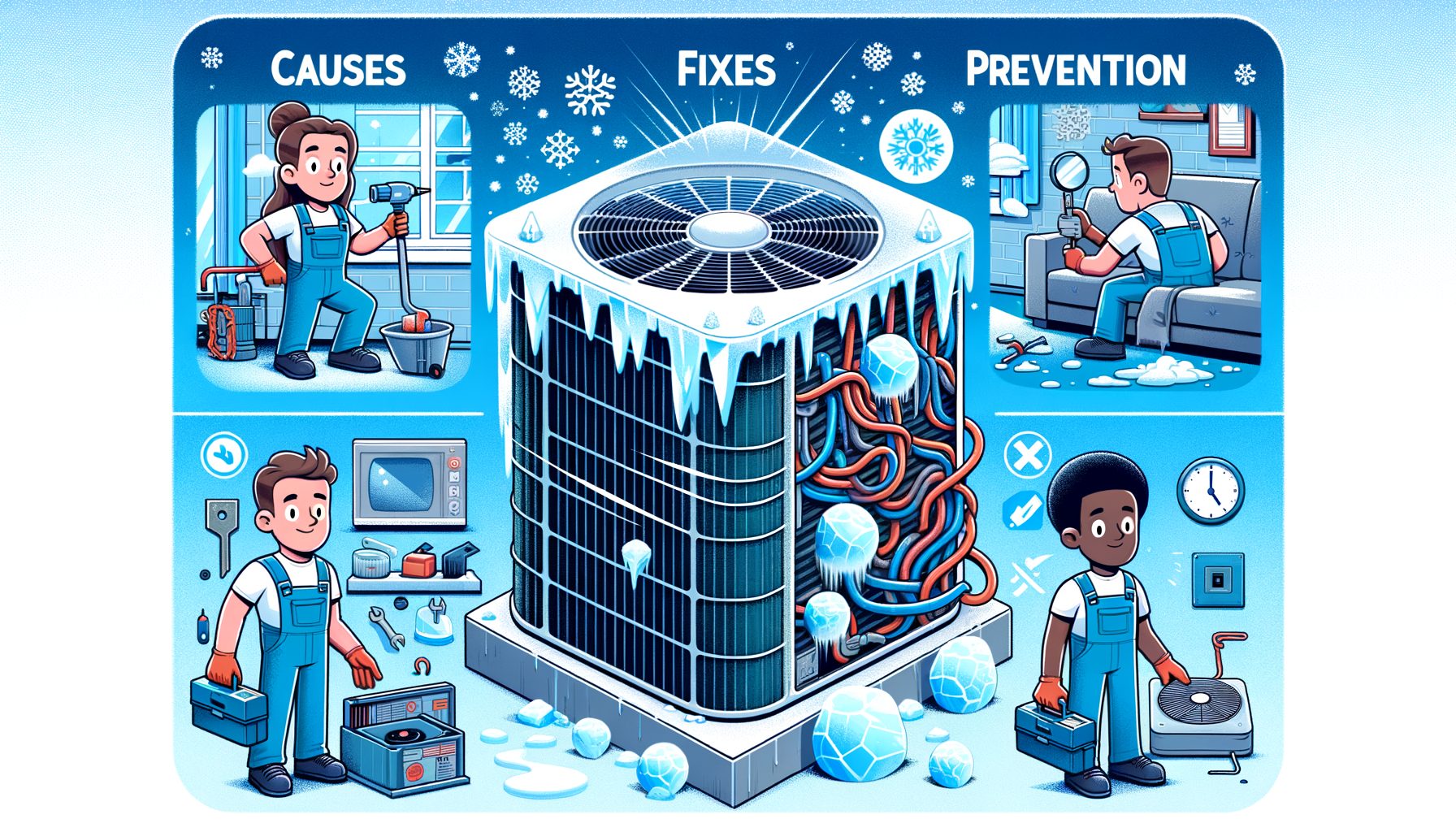
When your AC runs but the air feels weak or warm—and you see ice on the copper lines or the air handler—you’re dealing with a frozen evaporator coil. Common? Very. Frustrating? Absolutely. The upside: it’s often fixable without replacing the system. A freeze-up happens when the coil surface dips below 32°F (0°C), moisture turns to ice, airflow is choked off, and components get stressed. In the guide below, you’ll learn why coils ice over, how to thaw and restart cooling safely, which repairs address the cause, and the habits that keep it from returning. Read on to get your AC back on track fast, prevent repeat freeze-ups, and protect both your energy bill and your compressor.
The real reasons your AC coil freezes (and how to spot them)
At its core, every freeze-up comes down to physics: the evaporator isn’t shedding heat the way it should. Sometimes there isn’t enough warm air passing over the coil (an airflow problem). Other times the refrigerant side runs too cold for the conditions (a charge or metering issue). In everyday service, restricted airflow is the usual culprit—dirty filters, closed or blocked vents, a matted evaporator coil, a clogged return grille, a failing blower motor, or undersized/leaky ducts. The second big cause is low refrigerant from a leak, which drops pressure and temperature in the coil until it falls below freezing. Less common triggers include ultra-low thermostat settings in humid weather, a blower stuck on low speed, a faulty expansion device, or an iced condensate pan that re-freezes the coil base.
A healthy evaporator typically runs around 40–50°F (4–10°C) at the surface. Cut airflow and the coil can’t absorb enough heat, so it gets colder. Moisture from the air hits that too-cold surface and turns to frost. As frost builds, airflow is reduced further—a feedback loop that quickly grows into solid ice. You might notice weak airflow at the registers, hissing or gurgling at the air handler, puddles after thaw, and a drop in the supply/return temperature difference (“delta-T”). Low refrigerant behaves differently: cooling may seem okay at first, then the system gradually ices up, especially on muggy days.
The quick reference below links symptoms to likely causes and first checks. These aren’t lab tests—just practical indicators to help you focus before calling a pro.
| Symptom | What it suggests | Most likely cause | First checks |
|---|---|---|---|
| Ice on indoor coil or suction line | Coil below 32°F (0°C) | Restricted airflow or low refrigerant | Filter, vents, blower operation, listen for hissing, look for oily residue at joints |
| Very weak airflow, loud return | Fan/duct restriction | Dirty filter or blocked return | Replace filter, clear furniture from returns, open doors/registers |
| Short, repeated cycles; cold ducts | Overcooling coil | Oversized AC or thermostat too low | Raise setpoint, enable longer minimum run-time if available |
| Cooling fades after 30–60 min | Pressure drop over time | Low charge (leak) or dirty evaporator | Inspect coil face, schedule leak test |
| Water under air handler after thaw | Drain not handling melt | Clogged condensate drain | Clear drain trap/line, verify slope |
Out in the field, techs see the same pattern: restore airflow (filter, vents, coil cleaning, blower speed) and the icing usually stops. Big part replacements help far less often. That’s why your first 15 minutes should target everything that moves air.
Step-by-step AC frozen coil troubleshooting you can safely do
First priority: stop the freeze and thaw the coil. Running the system while iced risks liquid slugging the compressor. Here’s how:
1) Turn AC mode OFF and set the thermostat fan to ON. Doing so forces room-temperature air across the coil and speeds thawing. No fan-only option? Shut the system OFF at the breaker and let it thaw naturally.
2) Give it time. Light icing may clear in 1–3 hours; heavy frost can need 6–24 hours. Place a towel or pan under the air handler to catch meltwater. If the drain pan overflows, turn the fan OFF and clear the drain before continuing.
3) Check and replace the air filter. Even a “not awful” filter can starve airflow. When in doubt, swap in a fresh, correctly sized filter. High-MERV is fine if the rack is sized for it; a tiny rack plus an ultra-high MERV often equals too much resistance.
4) Open all supply registers and clear returns. Keep at least 80% of registers fully open. Move couches, rugs, or cabinets away from grilles. Close interior doors only if rooms have dedicated return paths; otherwise, leave doors ajar so air can get back to the return.
5) Inspect blower operation. With the fan ON, confirm strong air from multiple supplies. Weak flow or odd noises can point to a failing motor, a clogged wheel, or a stuck low speed. If viewing is safe, look for heavy dust on blower blades—it can slash airflow.
6) Look at the evaporator coil face (if accessible). Remove the access panel and check for lint or matted dust on the fins. Don’t poke the fins; they bend easily. A dirty coil drives repeat freeze-ups. If it’s visibly dirty, plan a cleaning after thaw (DIY with a gentle, no‑rinse cleaner if you can access it; otherwise, schedule a pro).
7) Verify the condensate drain. A clogged trap or line can back up water and create ice at the coil base. Clear with a wet/dry vacuum at the outside outlet or use a small brush at the trap. Later, confirm a steady drip while cooling.
8) Check thermostat and settings. In humid climates, very low setpoints (64–68°F / 18–20°C) can push the coil below freezing during long runs. After thawing, aim for 72–76°F (22–24°C) and enable minimum run-time or “circulate” modes if available to smooth humidity and airflow.
9) Evaluate the outdoor unit. Make sure the condenser coil is clean and the fan runs. A dirty outdoor coil won’t directly cause indoor ice, but the added stress can aggravate low-pressure conditions. Power down first, then gently hose debris from the outside in; avoid high-pressure streams that bend fins.
10) Restart and check a simple delta-T. Once thawed, run cooling 15 minutes and measure temperature at a return grille and a supply closest to the air handler. A healthy drop is typically 16–22°F (9–12°C). Much lower suggests low airflow; much higher can hint at low charge or other issues. Use this as a guide, not a final diagnosis.
If ice reappears within hours—despite a clean filter and open vents—suspect low refrigerant, a metering device fault, or a deeper airflow choke (dirty evaporator you couldn’t see, a collapsed duct, or blower speed/ECM problems). At that stage, a licensed HVAC technician is the safest path.
Fixes that usually work—and when to call a pro
Many frozen-coil cases disappear with simple, low-cost steps that restore airflow and drainage. Start here:
– Replace filters on time. In homes with pets or dust, monthly checks make sense. A clean, properly sized MERV 8–11 filter suits most households. Need higher MERV for allergies? Consider a larger media cabinet to keep resistance reasonable.
– Clean the evaporator coil and blower. Professional coil cleaning removes matted dust and straightens fins. The blower wheel often needs a scrub too; dirty blades can cut airflow by 20–40%.
– Clear and treat the condensate drain. Flush the line, verify the trap, and place an algaecide tablet in the pan during cooling season to prevent bio-slime.
– Unblock and rebalance airflow. Keep furniture and drapes away from returns, open most registers, and fix obvious duct kinks. Chronic room issues deserve a static-pressure check and balancing by a duct pro.
– Adjust thermostat strategy. Avoid ultra-low setpoints in humid weather. Use gradual setbacks rather than big swings, and enable any dehumidification features your system or thermostat offers.
Call a licensed technician for the following; gauges, EPA-certified refrigerant handling, or electrical work are required:
– Refrigerant leak check and correct charge. Low charge is both symptom and cause. “Topping off” without repair is short-lived and may be illegal in some regions. A pro will measure superheat/subcooling, locate and fix leaks, pull a vacuum, and weigh in the proper charge.
– Expansion valve or capillary orifice issues. A stuck or misadjusted metering device can starve the coil and trigger icing, especially at part load.
– Blower motor speeds and ECM programming. Wrong fan speed or a failing motor reduces airflow. Technicians set proper CFM per ton to match ducts and equipment.
– Duct diagnostics and sealing. High static pressure from undersized or leaky ducts often hides behind repeat freeze-ups. A duct blaster test and targeted sealing or resizing can remove airflow bottlenecks for good.
Typical cost ranges (vary by region and system): filter $10–$40; professional coil clean $150–$500; drain clearing $100–$250; leak search/repair with recharge $400–$1,500+; blower motor $300–$900; duct sealing or modifications $500–$3,000. While prices vary, the cost of repeated icing—higher bills, water damage, compressor wear—adds up. Fixing the root cause early usually costs less over the life of the system.
Note: In many countries, refrigerant handling requires certification. In the U.S., for example, EPA Section 608 limits who can service refrigerant circuits. Always verify your technician is licensed and insured.
Preventing frozen AC coils for good
Once the system is thawed and cooling again, prevention hinges on steady airflow, clean heat-exchange surfaces, and sensible setpoints. Build these habits into your routine:
– Filter discipline: Check monthly and change as needed. A good rule of thumb: every 60–90 days for typical homes, 30–45 days with pets, or follow your thermostat’s filter indicator. Don’t run without a filter—dust will load the coil.
– Annual professional service: A spring tune-up should include coil inspection/cleaning, blower check, drain service, refrigerant performance checks, and verification of fan speeds and static pressure. It isn’t merely “nice to have”—it keeps the coil out of the danger zone on the hottest, stickiest days.
– Keep vents and returns clear: Treat return grilles like intakes—they need open space. If you must close a few supply registers, keep at least 80% open to avoid high duct pressure.
– Manage humidity: High indoor humidity accelerates frost. Use bath and kitchen exhaust, fix plumbing leaks, and consider a dehumidifier or equipment with dedicated dehumidification in tropical or coastal climates.
– Smart thermostat settings: Avoid extreme setpoints. Program gradual setbacks and enable fan circulate (e.g., 10–20 minutes per hour) if your ductwork supports it. Some smart stats can enforce minimum run-time and alert you to abnormal temperature splits.
– Keep the outdoor condenser clean: Rinse debris gently a couple of times per season. Maintain 24–36 inches (60–90 cm) of clearance around the unit for proper airflow.
– Watch your KPIs: A few quick checks can warn you before ice forms. After 15 minutes of cooling on a warm day, measure return and supply temperatures and listen for smooth, even airflow.
| Indicator | Healthy range/expectation | What to do if out of range |
|---|---|---|
| Temperature split (return to nearest supply) | 16–22°F (9–12°C) | Too low: check filter/vents/coil; Too high: call for charge/airflow diagnostics |
| Condensate flow during cooling | Steady drip/trickle | No flow: inspect drain; overflow: clear trap/line |
| Airflow “feel” at multiple registers | Consistent, strong | Weak in several rooms: filter/coil/blower; One room only: duct issue |
| Noise from air handler | Smooth hum, no whistling | Whistle: return blockage; Rattle: blower/duct issue |
If you travel or run the AC only occasionally, set reminders for filter checks and consider a Wi‑Fi thermostat with system health alerts. Early warnings catch small airflow slips before they become a full-blown freeze.
FAQ: AC frozen coil basics
Q: How long does it take to thaw a frozen AC coil? A: With cooling OFF and the fan ON, light frost can melt in 1–3 hours; heavy ice may need 6–24 hours. Always stage towels or a pan under the air handler and clear a clogged drain first.
Q: Can I keep running the fan while it’s frozen? A: Yes. Running only the fan helps thaw the coil safely. Avoid running the compressor with ice present—it can damage the compressor.
Q: Does low refrigerant always mean I have a leak? A: In a sealed system, refrigerant isn’t consumed. A low charge almost always indicates a leak. A licensed technician should leak-test, repair, evacuate, and recharge to the manufacturer’s specs.
Q: Is it safe to clean my evaporator coil myself? A: If accessible and you follow the manufacturer’s directions, a gentle, non-acid, no-rinse cleaner can help. Protect electronics and avoid bending fins. Tight access or heavy soil calls for a pro.
Q: What thermostat setting prevents freezing in humid climates? A: Avoid very low setpoints (below ~70°F/21°C) during peak humidity. Use moderate setpoints, gradual setbacks, and any available dehumidification features.
Conclusion: stop the ice cycle, protect your comfort, and keep bills low
Frozen coils aren’t mysterious—they’re a symptom. In most homes, airflow got choked, the coil fell below freezing, and moisture turned to ice. You now know the usual suspects (airflow restrictions, low charge, poor settings), the safe steps to thaw and restart, the fixes that last, and the preventative habits that keep cooling steady. With a clean filter, clear returns, a healthy blower, and a verified drain, many systems run for years without a single freeze-up. And when signs point to refrigerant or metering issues, a certified pro’s diagnostics can prevent costly compressor damage.
Act now: if your coil is frozen today, switch cooling OFF and fan ON, replace the filter, open all vents, clear the drain, and schedule a professional inspection if icing returns after thawing. If your system is running fine, take five minutes to set a filter reminder, gently rinse the outdoor unit, and note your typical temperature split so you’ll catch early warning signs.
Comfort doesn’t have to be complicated. A few smart habits and timely maintenance move your AC from “works most days” to “reliably cool, quiet, and efficient.” Your home feels better, energy costs drop, and equipment lasts longer. Ready to lock in no-ice cooling? Start with the simplest step—check that filter today—and keep the cool air (not your coil) flowing. What small change will you make right now to prevent the next freeze?
Helpful resources:
U.S. Department of Energy: Maintaining Your Air Conditioner
ENERGY STAR: Heating & Cooling Tips
U.S. EPA: Refrigerant Management Requirements (Section 608)
ASHRAE: Technical Resources on HVAC Performance
AHRI: Consumer HVAC Information
Sources:
– U.S. Department of Energy, Energy Saver: Maintaining Your Air Conditioner
– ENERGY STAR, Heating & Cooling
– U.S. Environmental Protection Agency, Section 608
– ASHRAE Technical Resources
– AHRI Consumer Resources